
Lampasas Projected Versus Actual Release
A projected date is a calculation, not proof that someone left custody. In the Texas Department of Criminal Justice record, it may reflect the applicable release framework, credits, offense date, eligibility, and sentence information. A scheduled date appears later in the release process, when TDCJ is preparing to implement a release. The actual release date records that institutional custody ended. Final discharge may occur still later if parole or mandatory supervision continues.
County custody works differently. A person awaiting trial at Lampasas County Jail does not have a sentence-based projected release date. Bond, dismissal, a court order, a detainer, or transfer may control the next event. A sentenced county inmate requires the judgment, sentence start, credit for time served, and the jail’s applied calculation. TDCJ’s projected field cannot be used to calculate a Lampasas county-jail term.
Release also needs a destination. Lampasas may transfer a person to Burnet County under its interlocal housing arrangement, to TDCJ, or to another custodian. An out time from the local jail can therefore document transfer rather than freedom.
Find Lampasas Projected Release Dates
Classify the last known custody before searching. The official TDCJ search covers people who entered Texas prison or state-jail custody. It does not cover an ordinary Lampasas detainee who bonded out, received local probation, or served a county sentence. Use an identifier when possible because names can match.
The TDCJ offender-information gateway is the official starting point for the state search and its agency fallbacks.
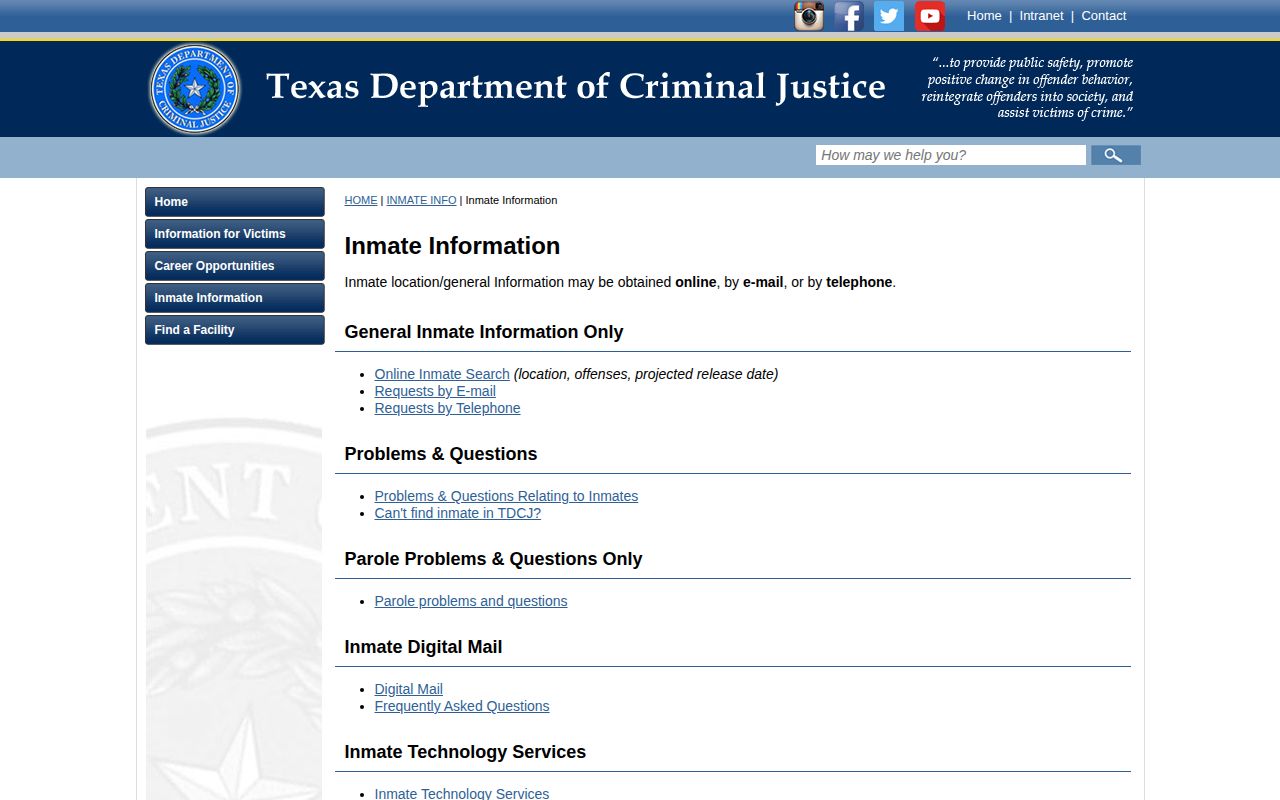
The gateway keeps the TDCJ search separate from Lampasas County Jail records and helps prevent a county detainee from being searched in the wrong system.
- Identify the custody system. Confirm whether the person is at Lampasas County Jail, held under the Burnet housing path, transferred to TDCJ, or in another agency’s custody.
- Search TDCJ when applicable. Open the TDCJ Online Inmate Search. Prefer the TDCJ or SID number; otherwise use first and last name.
- Compare the person. Check conviction county, offense, sentence, location, and identifiers. Do not rely on the name alone.
- Read status before dates. Transcribe each field label exactly. Projected Release Date, parole eligibility, review status, Scheduled Release Date, and actual release answer different questions.
- Use the county path for local terms. Ask the Lampasas jail for the booking-out or release/transfer entry and obtain the judgment or release order from the correct court.
- Confirm the event. Recheck TDCJ IVSS or the holding agency near the date. Record the access date because a calculation can change.
If the TDCJ name search has no match, check spelling and identifiers before drawing a conclusion. The person may never have entered state custody, or a recent transfer may not yet appear. The Lampasas County released inmate search gives the broader county, court, and transfer-verification path.
Note: “No matching result” describes the search inputs and does not prove release, discharge, or the absence of another custodian.
Texas Good Time for Lampasas Cases
Texas has no universal rule requiring every TDCJ prisoner to serve 85 percent of a sentence. That shorthand comes from a different framework and should not be imported into a Lampasas case. Texas calculations vary with the offense, offense date, imposed sentence, statutory exclusions, actual calendar time, good-conduct credit, mandatory-supervision rules, and Board decisions.
Government Code Sections 498.003 through 498.005 govern good-conduct classifications, accrual, forfeiture, and restoration. Section 498.005 is crucial: good-conduct time affects parole or mandatory-supervision eligibility and generally does not shorten the sentence imposed by the court. Credits can change an eligibility or projected calculation without erasing the judicial maximum.
Mandatory supervision has its own rules. Section 508.147 uses calendar time plus accrued good-conduct time reaching the maximum term as a benchmark, but Section 508.149 lists exclusions and permits discretionary denial in covered later cases. Parole eligibility is governed by Section 508.145. For offenses listed in subsection (d), eligibility may require actual calendar time equal to one-half of the sentence or thirty years, whichever is less, without counting good time and subject to a minimum. Other offenses have other rules.
Offense date also changes the meaning of the projected field. For an eligible case before September 1, 1996, TDCJ may use the mandatory-supervision point if parole has not occurred. For later offenses, an otherwise eligible mandatory-supervision release can be discretionary with the Board. If the person is excluded or release is not approved, the projection may instead reflect discharge. The field must be read with eligibility and status, not in isolation.
Good-time note: Do not calculate a person’s date by applying one credit rate or percentage. Read the official TDCJ field and verify the offense-specific law.
Why Lampasas Release Dates Change
A date can move when the facts used in the calculation change or when release processing is not complete. Some changes affect eligibility. Others affect when the approved release can be carried out. The official record should state the new field rather than leaving the reader to reconstruct the arithmetic.
| Factor | Possible effect | Best record to check |
|---|---|---|
| Credit correction | Changes the calculated eligibility or projected field | TDCJ detail and Classification and Records |
| Disciplinary forfeiture | Good-conduct time may be lost or later restored under state rules | TDCJ calculation and conduct record |
| New sentence or court order | Changes the legal basis or time to be served | Filed judgment, sentence, or amended order |
| Detainer or hold | May send the person to another custodian instead of the community | Release/transfer entry and receiving-agency record |
| Board action | Approval, denial, next review, or conditions affect the release route | TDCJ detail and Board decision code |
| Program completion | A required program may delay implementation after approval | TDCJ release-processing status |
| Residence approval | An incomplete or rejected plan can delay a scheduled release | Parole release-processing confirmation |
A parole approval is not a gate date. TDCJ Classification and Records must audit the release certificate and computation. TDCJ’s published process estimate says this audit generally takes fourteen to twenty-one business days after receipt, while post-program cases may take four to six weeks based on needed information and residence approval. These are process estimates, not promises for one person.
Even a date shown on the scheduled day may move. A final hold can change the destination, a calculation audit can change the date, and a required release plan may remain incomplete. Recheck the official detail close to the event and ask the holding agency whether the result was community release, supervised release, or transfer. That last distinction prevents a real out time from being described as freedom when another custodian received the person.
Lampasas TDCJ Date Hierarchy
The label controls the meaning. Parole eligibility is the earliest point for statutory consideration under the applicable rule. It does not direct release. Parole review date or status describes Board processing. Projected Release Date is TDCJ’s calculated field. Scheduled Release Date appears during final implementation and can still change. Actual release date records departure from institutional custody. Discharge marks completion of the sentence or supervision when used in that final sense.
| Date or status | What it answers |
|---|---|
| Parole eligibility | When review may first be allowed under the governing rule |
| Parole review | Where the Board’s file review or voting process stands |
| Projected Release Date | TDCJ’s current calculated release or discharge projection |
| Scheduled Release Date | A planned date during final processing, still subject to change |
| Actual release date | When institutional custody ended |
| Discharge | When the sentence or supervision finally ended |
Keep the exact wording in notes and records requests. Calling eligibility a “release date” or parole release a “discharge” can turn one timeline into a false claim. TDCJ IVSS can help distinguish in custody, on supervision, expected release, and actual release.
Note: Save the date of access with each result because TDCJ status, location, and calculated dates may change.
Lampasas County Jail Date Limits
No Lampasas-specific county-jail good-time schedule, weekend-release policy, or public release-hours rule was located. That absence is important. TDCJ statutes and TDCJ’s projected field cannot be copied onto a county sentence. Ask for the judgment, sentence start, credit for time served, and the jail’s applied calculation.
A court order may authorize release before staff complete identity checks, other-hold review, property processing, and booking-out work. The signed order time and actual out time can therefore differ. For a precise Lampasas answer, request both the legal release authority and the jail-register or booking-out entry. If the record says “released to” another agency, follow the destination system rather than describing a community release.
The Burnet County agreement makes this more than a theoretical concern. Lampasas transports people between the facilities and to TDCJ. A person absent from the Barnes Street jail may remain held under the contracted arrangement or may be in state transit. Ask whether the event was release or transfer and request the receiving agency when public.
For a durable record, request the permanent jail-register entry. Texas retention Schedule PS4200-06 requires that summary record to include the release or transfer date and keeps the register permanently. Booking-out forms and legal release or transfer orders fall within the prisoner incarceration file, which has a minimum retention of release or transfer plus two years. Retention does not guarantee public access to every field, but it identifies the record categories to request after a short-lived status is gone.
Confirm Lampasas Actual Release
For state custody, use TDCJ IVSS to look for actual release and on-supervision status. If an official search is unavailable or unclear, TDCJ offers a no-charge email-information route at pia@tdcj.texas.gov. Include the full name and seven-digit TDCJ number, or exact date of birth when the number is unknown, and ask for the specific incarceration detail and Projected Release Date.
For county custody, call Lampasas County Jail at 512-556-8255 and ask whether the person is currently held. If not, ask whether the event was a release or transfer, the date and type, and the receiving agency if releasable. Documentary proof comes from the permanent jail-register entry, booking-out form, and release or transfer order.
Notification is useful but must be read precisely. Texas IVSS-Counties can report a county release or transfer event, while TDCJ IVSS covers state custody and parole. A transfer alert ends one custody segment; it does not prove freedom. The separate VINELink check page explains the current Texas IVSS transition and one-person alert path.