
Lampasas Parole Versus Probation
Parole follows a term in Texas Department of Criminal Justice custody. The Texas Board of Pardons and Paroles makes release and revocation decisions, while the TDCJ Parole Division supervises the person after release. Probation, called community supervision in Texas law, comes from the sentencing court. Lampasas County Adult Probation, also known as the Community Supervision and Corrections Department or CSCD, handles that local court supervision.
The distinction affects every search. TDCJ offender information and TDCJ IVSS can identify a state prisoner who was released to parole or mandatory supervision. Lampasas CSCD does not publish a probationer search. A probation sentence is instead confirmed through the sentencing court’s judgment, probation order, or later discharge order, with the local office used for proper routing.
| Point | Parole | Probation |
|---|---|---|
| How it begins | Release from TDCJ custody under a Board decision or state release rule | A court orders community supervision as part of the case disposition |
| Decision authority | Texas Board of Pardons and Paroles | The sentencing court |
| Supervising office | TDCJ Parole Division, with Lampasas routed to Temple | Lampasas County Adult Probation/CSCD |
| Public verification | TDCJ offender search and TDCJ IVSS, then office confirmation | Court judgment, supervision order, or discharge order |
| How it ends | Discharge from the sentence or another official termination | Court discharge, early termination, or other court action |
Mandatory supervision is also a state release status. It is not county probation. A person may be physically outside prison yet remain in the legal custody of the TDCJ Parole Division until discharge.
- Parole
- Conditional release from state prison before final sentence discharge.
- Probation
- A court-ordered sentence served in the community under stated terms.
- Mandatory supervision
- A statutory form of supervised state release, subject to eligibility and Board rules.
- Absconder
- A person alleged to have stopped reporting or left supervision without authorization.
- Discharge
- The official end of a sentence or supervision term, not merely release from a building.
Verify Lampasas Post-Release Supervision
Start with the type of custody or sentence already known. Someone released from TDCJ belongs in the state search path. Someone sentenced directly to community supervision belongs in the Lampasas court and CSCD path. If the sentence is unclear, use the cause number and filed judgment before assuming that any release created parole.
- Confirm identity and jurisdiction. Gather the full legal name, TDCJ or SID number if known, and the county of conviction. Compare identifiers before accepting a same-name result.
- Check the state record. Search the official TDCJ offender search. Read location and status before interpreting projected, scheduled, or parole-review dates.
- Check release and supervision. Use TDCJ IVSS for actual release data, on-supervision status, and the current parole office when those fields appear.
- Route state parole locally. TDCJ assigns Lampasas County parole cases to the Temple District Parole Office in Region IV. The office may route a proper status inquiry, though confidential case details may not be released.
- Verify probation through court. Obtain the judgment or community-supervision order from the court that imposed it. Contact Lampasas CSCD for office routing, not as a substitute for the filed court record.
- Look for the ending record. A court discharge or TDCJ discharge status shows more than a jail release date. Keep release and final discharge as separate events.
If TDCJ returns no match, do not treat that absence as proof that there is no supervision. The person may have received county probation, may have a spelling variation, or may never have entered TDCJ. The full county release path is described on the Lampasas County released inmates search.
Note: A projected date, Board vote, or release alert does not by itself prove that physical release or final discharge occurred.
Lampasas Supervision Office Split
Lampasas has a local adult probation office, but state parole is routed outside the county. That split is easy to miss. The CSCD office handles court-ordered probation questions. The Temple office handles TDCJ parole supervision assigned by county. Neither office should be asked to certify a custody event that belongs to the jail or another agency.
Lampasas Adult Probation / CSCD
409 S. Pecan Street, Suite 105
Lampasas, TX 76550
Phone: 512-556-8279
Fax: 512-556-0103
TDCJ Temple District Parole Office
Region IV
3516 Profit Place
Temple, TX 76502
Phone: 254-933-0535
Fax: 254-939-5379
The TDCJ county office cross-reference is the authority for the Temple routing. For a release already approved by the Board, Review and Release Processing answers process questions at 512-406-5202. An approval still may require audit, program completion, or residence approval before release.
The official Region IV district-office page documents the Temple office details used for Lampasas parole routing.
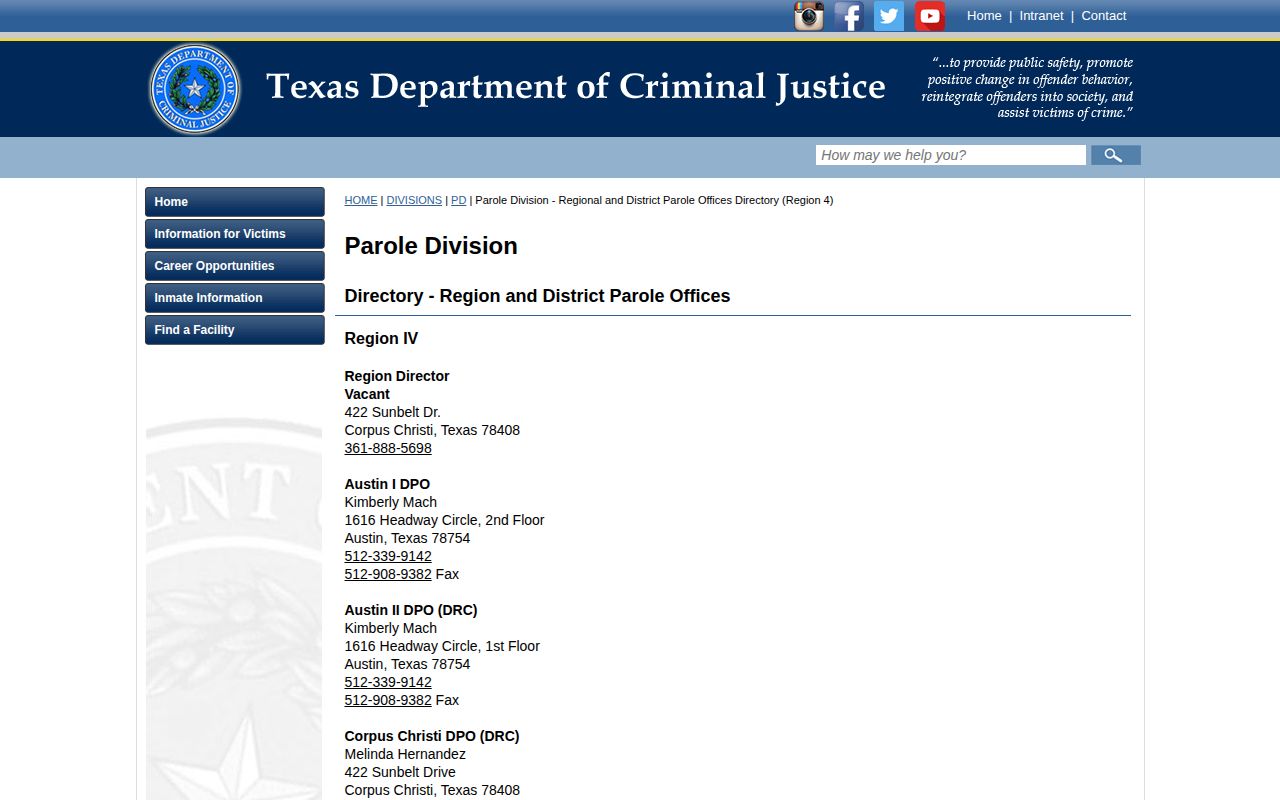
This state directory distinguishes the assigned parole office from Lampasas County’s separate adult probation office.
For notification rather than office routing, TDCJ Victim Services supports the state IVSS channel at 800-848-4284 and victim.svc@tdcj.texas.gov. County custody notices use the separate Texas IVSS-Counties service. A county alert that says transfer to TDCJ closes the Lampasas jail segment but begins the state-custody segment. Register in the state system after the transfer instead of expecting the county record to track later parole review, release, or discharge.
Lampasas Supervision Warrants and Violations
Conditions are the rules attached to supervision. They may include reporting, approved residence, travel limits, fees, treatment, or other terms stated in the person’s official order. The exact terms are person-specific. A general web summary cannot establish them, and the supervising office may restrict what it can disclose.
An alleged violation can lead to a warrant and detention. An absconder label generally means the agency alleges that the person stopped reporting or could not be located as required. Lampasas County publishes no official probationer lookup, probation absconder list, or sheriff most-wanted list. A municipal warrant check is limited to that municipal court and is not a statewide warrant search.
A parole revocation hearing is different from ordinary parole review. Revocation occurs after release and addresses an alleged breach of supervision. The outcome may continue, change, or revoke supervision. Confirm the present custody agency as well as the warrant or hearing status.
Lampasas Parole Review Has No Calendar
Texas does not hold a formal public hearing for ordinary parole or mandatory-release consideration. The Board’s own explanation says panel members review and vote case files individually. There is therefore no public Lampasas inmate hearing calendar or mass decision calendar to search. Quarterly Board meetings concern policy and administration, not named-person parole decisions.
The Parole Division identifies cases before eligibility, an institutional parole officer prepares a summary, and a three-member panel votes in sequence. Two matching votes decide the case. The offender detail can show review timing or status, and the current voting-options brochure explains codes such as FI, NR, RMS, DMS, and program-conditioned decisions. Eligibility is only the earliest point at which review may occur. It is not an order to release.
An FI code is a favorable parole vote, sometimes tied to a program or later processing step. NR sets a later review point. RMS concerns mandatory-supervision release, while DMS denies that form of release. SA means serve all where that option applies. The code should be read with its full description and date because a short label alone does not show when the person will leave a unit.
Note: Board business meetings are not person-specific parole hearings and should never be used as an inmate release calendar.
Lampasas Release Papers and Property
Lampasas County publishes no jail-specific property-return procedure, identification handoff rule, or correction form. A person leaving the jail should ask the sheriff about release paperwork and property. If a jail-register or booking entry appears wrong, identify the exact record, intake or cause number, disputed field, and proof supporting the correction. A broad claim that the record is wrong gives the custodian less to act on.
Texas Code of Criminal Procedure Article 55A.451 adds one distinct document duty. The official responsible for release or discharge must give the person written information about Chapter 55A expunction rights and a copy of the chapter. That notice does not mean the case qualifies for expunction. Eligibility remains fact-specific and depends on the statute and court process.
This local gap matters after release. Property and identification questions belong with the Lampasas County Sheriff, probation reporting questions with CSCD, and parole reporting questions with the Temple office. Keeping those routes separate reduces delays and prevents a record request from becoming an unsupported supervision inquiry.
Lampasas Supervision Discharge Records
Physical release and final discharge are not synonyms. A parolee may leave prison yet remain under TDCJ legal custody. A probationer may complete a county jail condition while the court’s community-supervision term continues. The final record must therefore state which event ended: jail custody, prison custody, parole supervision, probation, or the full sentence.
For qualifying deferred adjudication, Texas Code of Criminal Procedure Article 42A.111 addresses dismissal and discharge after successful completion. Article 42A.701 governs reduction, termination, and discharge of regular community supervision. The filed court order is the strongest source for Lampasas probation completion. For state parole, use the exact TDCJ status and any official discharge record.
A clear timeline lists the sentence, release date, supervision type, any later warrant or change, and the discharge date. Do not fill gaps with assumptions. When the public search is unclear, request the existing court or agency record that names the event.